

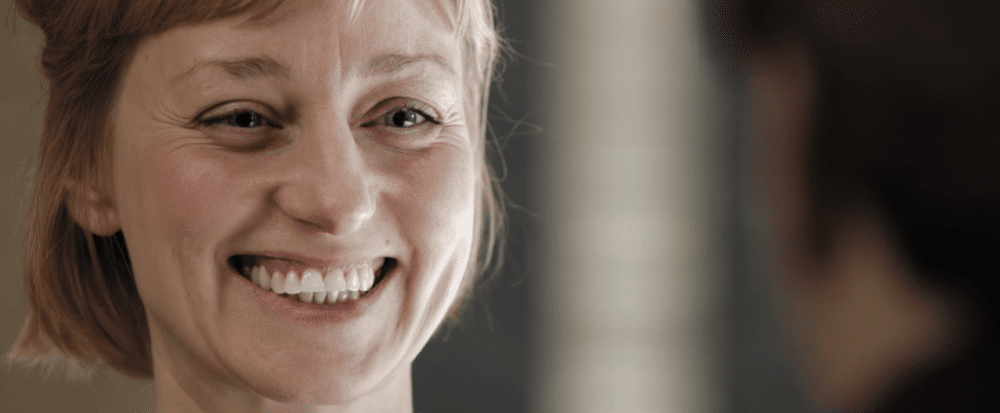
In the face of the growing social mood related to the migration crisis, we were asked by the local Amnesty International branch to prepare a social campaign for refugees. This is how the movie “Look Beyond Borders” was made. Moving, thought-provoking, important. The film, which has been seen by over 41 million people around the world, and the total reach of the campaign has built up to 930 million people, making it the most reachable in the history of global Amnesty International. That’s all with the media budget of only 23 €. Do you think that’s impossible? Well, I invite you to read further.
Let’s start from the beginning…
It is no secret that now the world, and in particular the old continent, is facing a huge humanitarian crisis. The number of refugees exceeds of those after the Second World War. According to UN data, 1 out of 122 inhabitants of the globe is forced to leave their home. Yes, nearly 1% of us have no place to live for ourselves and their loved ones! In 2015 alone, 1 million people reached Europe. For obvious reasons, this is a topic for discussion in countries facing this problem and having to take responsibility for solving the crisis.
In all this, the drama of the human aspect is increasingly forgotten, and the only effect is a sharpened public discourse, giving political fuel to populists and a polarizing society.
How did we approach this?
We did not want to directly encourage the admission of refugees, thus adding their five cents to the barren discussion in the media and political salons that had been going on for months. Everything has already been said about this subject. What is particularly important – it is so conflicting that the campaign encouraging the admission of refugees could be mainly rebounded, thus contributing to even larger divisions. What we wanted was to take care of the extreme dehumanization of refugees and that caught our attention particularly.
In the face of the growing migration crisis, the human aspect has gone to the background. Refugees are not talked about as people fleeing persecution, but about the amounts to be adopted and the threatening economic and social problem.The opponent in our campaign were stereotypes and prejudices against what is different and foreign. They lead to unjustified hatred, taken from the fear and ignorance of refugees. This comes from polarization of politics and misleading media coverage, in which we rarely have access to individual stories and do not let refugees speak up for themselves.
Who was our target group?
We knew that we would not reach everyone efficiently, and persuading the declared opponents is pointless. We wanted to reach out and strengthen the support of people accepting refugees or those undecided, who on the one hand were afraid of their image from the media, on the other conscience teld them to help another person in need. For us, they were the most important – constituting nearly half of European societies (334 million people) were open to arguments and the possibility of changing their minds.
Starting from basics, meaning insight …
Increasing aversion to refugees for cultural, social and economic reasons, as well as prejudices resulting from misunderstanding of more and more noticeable cultural and religious differences. A widespread fear, compounded by more and more frequent terrorist attacks, which are mistakenly identified directly with refugees. All this meant that we decided to base our campaign on how universal insight, referring to the fear of the unknown rooted in people – “Every otherness causes anxiety. In refugees, we see a threat without trying to see another, valuable person “
… then the strategy …
Starting from this insight, we wanted to show that fear and hostility come from unjust stereotypes and sometimes it is enough to refute them when confronted with those they concern. We did not want to convince rationally that refugees are same as us, but to give everyone a chance to actually feel it.
For this reason, we used a psychological mechanism, for which mirror neurons are responsible, thanks to which we can feel the emotions of others. In a nutshell, it means that empathy awakens in us when seen in other person. Using this mechanism, we wanted to infect Europeans with it.
… and a great creative idea …
We used the psychological experiment of Arthur Aron, described by him as a “study of closeness.” Acording to his theory, a 4-minute eye contact is enough to strengthen the relationship with another human being.
Through the campaign’s movie we wanted to enable the audience to experience the experiment themselves, showing how little it takes to overcome foreignness and stereotypes towards refugees. We wanted to prove that in the migration crisis, first of all, it is important to recognize the other person who needs help in each refugee, through raising interest and moving people’s hearts.
… which we implemented.
In order to influence the largest number of people from our target group, we had to achieve the widest reach. With a negligible media and production budget, the creative execution was predetermined and focused on the viral effect.
We focused on emotional and qualitative creation, which could interest the media and move the hearts of Internet users, helping to carry out campaigns across Europe. The experiment was carried out in Berlin, which is an ideal place for that purpose. Germany is one of the countries that have received the largest number of refugees, and the city itself is a symbol of overcoming divisions.
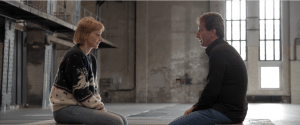
We invited Europeans and refugees, mainly from Syria, to participate. We shot the film in the hall, where the mixed-pair couples were seated opposite with their eyes closed, opened with the sign of a moderator. Participants did not know each other until that very moment, and their reactions were not arranged. Their spontaneous behavior had a gigantic emotional charge, being key to the success of the campaign. We created a moving movie from the filmed footage, showing how little it takes to look at the world through the eyes of another human being.
Despite the trend of short social videos, ours lasted as long as 5 minutes. It was a conscious undertaking to cause the greatest impact on the viewers. Such length requires concentration, allowing you to empathize with the experiment and almost experience it yourself. We put the created movie on YouTube and Amnesty social channels. We supported the campaign with media and PR, getting support from influencers and media.
What about the results?
The film dispersed through various channels on social media was watched by 41.3 million people, with the total number of 405 100 shares! “Look Beyond Borders” was mentioned by the largest media in Europe (including Die Welt, El País, Euronews) and in the world (including CNN, India Today, The Huffington Post) providing 826 publications in 46 countries. This way, we managed to generate nearly 481.8 million total reach in Europe alone, and the record of 930 million in the world! That’s all within a budget of just € 23!
 Thanks to this numbers the international secretariat of Amnesty International recognized it as the most effective in almost 60 years of the entire organization. For us, the most important thing is that we may have changed perspective of many people toward refugees.