

28/02, Brussels In honour of the Herstory theme behind this year’s Ad Venture Student Competition, which is organised in partnership with the European Women’s Lobby (EWL), the edcom team has been getting to grips with topics of gender equality and women’s rights. With two weeks left for our Ad Venture students to work on their campaigns, edcom decided to head out to find some more inspiration for its students. Our search brought us to a panel discussion at the European Parliament on the topic of the under-representation of women in executive positions, organised by our client EWL.
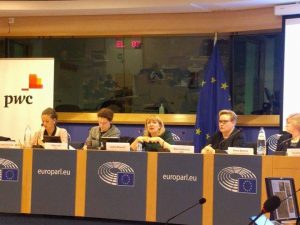 We enter the room and the title of the event – “Where are the executive women?” – is projected onto the wall behind us. There, a fantastic line-up awaited us: 7 highly successful women from across the private and public spheres. These included two MEPs from the European People’s Party (Angelika Miller and Sirpa Pietikainen), Gilly Lord: Account Manager at PwC, Grace Stevens: Chief Tax Officer at Legal & General Group, Karine Becker: Managing Partner at Higher and Hire, and Jason-Louise Graham from EU Panel Watch and ACP Young Professionals.
After a bit of mingling over a sandwich buffet, we take our seats and Gilly Lord opens the conference by explaining the particular way her daughter, aged nine, had interpreted the title of the day’s event, having that morning asked her: “Mummy, are you going on a treasure hunt to find all the women?” As the panel soon confirmed, there are indeed many “lost” executive women hiding in the rainy alleys of Brussels.
On average in Western Europe, only 25% of executive positions are held by women. In Eastern Europe, this proportion is slightly higher (at 34%) – a legacy of the more egalitarian communist era.
Yet, unfortunately for Gilly Lord’s daughter, as well as the rest of society, the problem is more complicated than simply locating these lost executive women. During the course of the panel discussion, three main problems were highlighted and discussed.
Unconscious bias and the fixed image of a male leader
All panel members agreed upon the important role that unconscious bias has in determining the face of the workplace. And as the name itself suggests, these kinds of decisions are made without even being recognised as prejudicial. Examples of unconscious bias can range from managers overlooking female employees for promotions because of an assumption that they will invest more time and energy into their family life, to the interpretation of a woman’s biologically softer voice as symptomatic of an “un-managerial” character style.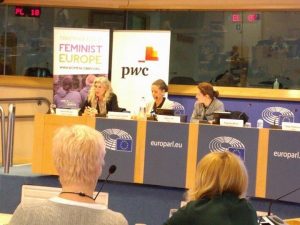
As Karine Becker highlighted, whilst women do tend to be less assertive than men, this is often translated to employers as evidence of “a lack of leadership” skills. However, as MEP Sirpa Pietikainen most clearly remarked, these assumptions are linked to a rather outdated attitude towards leadership:
“It is time we recognised a true diversity of leadership styles and recognise that one can gain leadership skills from all walks of life. First and foremost – being a mother, one of the most difficult jobs of all.”
Structure and culture of workplaces
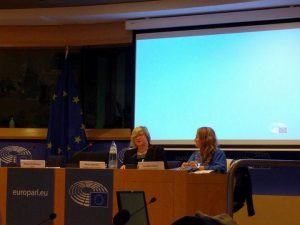 The panel also discussed the structural issues which can interfere with a woman’s rise to the top. In addition to highlighting the well-known challenges of inflexible maternity and childcare policies, Grace Stevens went on to raise the related point that women are often disadvantaged by the ‘one-size-fits-all’ assessment style used by employers. She explained that many employers continue to view the length of time spent physically in the office as evidence of an employee’s productivity and commitment to the job. However, numerous studies exist demonstrating that women are not only more productive within a shorter length of time, but that their work patterns also do not tend to fit within fixed hours. Whilst men more frequently stay at the office into the workday evening, women often return to their emails later on, once the kids are in bed.
On top of this, the panel also highlighted far more subtle aspects which can have a negative impact on a woman’s career. Most notably, the panellists from the private sector stressed the continued existence of typically “male” office cultures. As Grace Stevens put it: “In my profession, there is unfortunately still a lot of strategizing which women are left out of simply because they take place during “guy-to-guy” chats in the corridors or down the pub after work…”
… So, how do we make a change?
Create determined and confident women through mentoring
 The panel was clear. The first step to changing the face of the workplace is creating a generation of self-assured women who are unafraid to challenge gendered stereotypes surrounding assertiveness. However, this alone is a challenge in a society where girls start self-doubting their abilities at the age of 6.
Many of the panellists shared the opinion that the best practical way of boosting the confidence of women is by providing them, from the very beginning of their career, with guidance and support from more senior professionals in the industry. Such mentoring schemes can consist in periods of “shadowing” a senior executive or even participating in a “job swap”. Grace Stevens highlighted the importance of a simple dialogue between fellow professional women, who are often best placed to reinforce the confidence of each other: “Often it is as simple as two women sitting over coffee and encouraging each other to push themselves further.”
A change of approach at the recruitment stage: transparency, diversity and tackling bias
 The panel continued onwards to the other major driver of change in workplaces: the establishment of a principle of transparency regarding the gender divide in the workplace. The panellists explained that, in the context of an increasingly conscious and connected society, corporations and organisations are well aware of the reputational repercussions they could face for having an under-developed workplace diversity. This, together with the well-reported fact that real diversity – both gender and ethnic – is good for companies as this allows them to have more connection to a wider range of clients.
 Given that, as Grace Stevens put it, “what gets reported is what gets done”, establishing transparency (either as a matter of company principle, or enforced through the law) would provide management with a much-needed incentive to balance the gender divide in the management roles. According to recruitment guru Karine Becker, small changes to the recruitment procedure of companies can yield big changes in the long run. For example, introducing interview panels which are representative in terms of both gender and ethnicity is an effective way of tackling unconscious bias at the recruitment stage. In addition to this, organisations can benefit from setting quotas for different stages of the recruitment process, and then obliging their HR to explain themselves in cases where these targets are not met.
Students & HerStory
Listening to the thought-provoking analyses and ideas which emerged from the discussion left the edcom team thoroughly re-energised for its Ad Venture competition. edcom and EWL strive to contribute to the important debate by challenging students to create a campaign to raise awareness about gender inequality. With the deadline for students to submit their work on 15th March, we can’t wait to see what innovative and creative Herstory campaigns they have come up with!