Women in Media 2.0 Conference: How Women in Media Can Help Promote Positive Gender Models

Brussels – Two days ago, #7novembre16h34 was trending on Twitter. “From 7 November at 16.34 onwards, women effectively work for free for the rest of the year”, claims the organiser of the social media campaign, highlighting the 15% gender pay gap that exists in France, for instance. Gender inequality continues to exist in the 21st century and that is something that needs to change, finds Sofia Foundation, organiser of the Women in Media 2.0 Conference that was held in Brussels on 26/10/2016. In recognition of this challenge, EACA ‘s European Institute for Commercial Communication Education (edcom) focuses on the theme of gender equality through its annual Ad Venture Student Competition. At the conference “Women in media 2.0”, media houses and employees were encouraged to take direct action and support positive gender models to tackle gender inequality and break gender stereotypes.

When women want to, they can drive the change we want to see

14976536_1826799614227422_3203400155285281150_o
Madi Sharma

Madi Sharma, an educational entrepreneur and motivational speaker, drove home her ‘no excuses’ mantra to the overwhelmingly female audience:

“I want to say one thing. We, women, are very happy to sit and talk in panels like these but we are simply not doing enough and we need to stop blaming everyone else for that. We have seen that when women want to, they can drive the change they want to see – just look at Iceland and Poland. We are stereotyping all the way, even towards ourselves”.

She continued to provide further inspiration by giving the audience two practical examples of ways that women can make a change as a collective. Firstly, she stressed that women hold 86% of the purchasing power in society and that this power can easily be used to protest against media houses that continue to play into outdated sexist stereotypes of women. Secondly, Sharma pointed out that the strength of blogs and social media demonstrates a new ‘digital and decentralised’ media era. She urged women to seize upon these channels so that they can gain the coverage and exposure that traditional media fails to give them.


There is a need for systemic change in media organisations

Key speaker Nanette Braun, UN Women Ambassador, stressed the need for systemic change in media organisations and highlighted a number of shocking imbalances. These included facts such as:

cwwidtawgaajr4p
  Nanette Braun
  • Less than 25% of news pieces concern women
  • Only 25% of the experts cited in the media are female
  • Only 50% of films that came out in 2015 pass the ‘Bechdel’ test (meaning that it contains a scene where two female characters have a conversation about something other than a man).

However, it’s not all doom and gloom. Citing the success of the HeforShe campaign, she stressed that social media provides potential to promote gender equality because media houses have a standing reputation to invest in maintaining an inclusive image:

“Media companies are now realising that gender equality is not only a social ideal, but also a business imperative…Women are half of the human story, media houses who forget this will ultimately deliver poorer products”.

women-2-editFollowing up on this thought, panelist Alison Maitland, former Financial Times journalist, underlined that there is a need for a critical mass of women in media. She said: “a few token women cannot carry the weight of the entirety of ‘women’s issues’. It is only when this critical mass has been reached that women are no longer seen as ‘just women'”.  Annette Young, journalist at France24 and founder of 51%, fiercely agreed with Maitland and highlighted that a lack of gender balance is causing journalism itself to suffer:

There is a need to rethink the idea, that we have in this profession, that good journalism means covering war zones…Good journalism also means covering social change, and we are currently in a social revolution – a gender revolution.”

What it all comes down to: promoting positive gender models

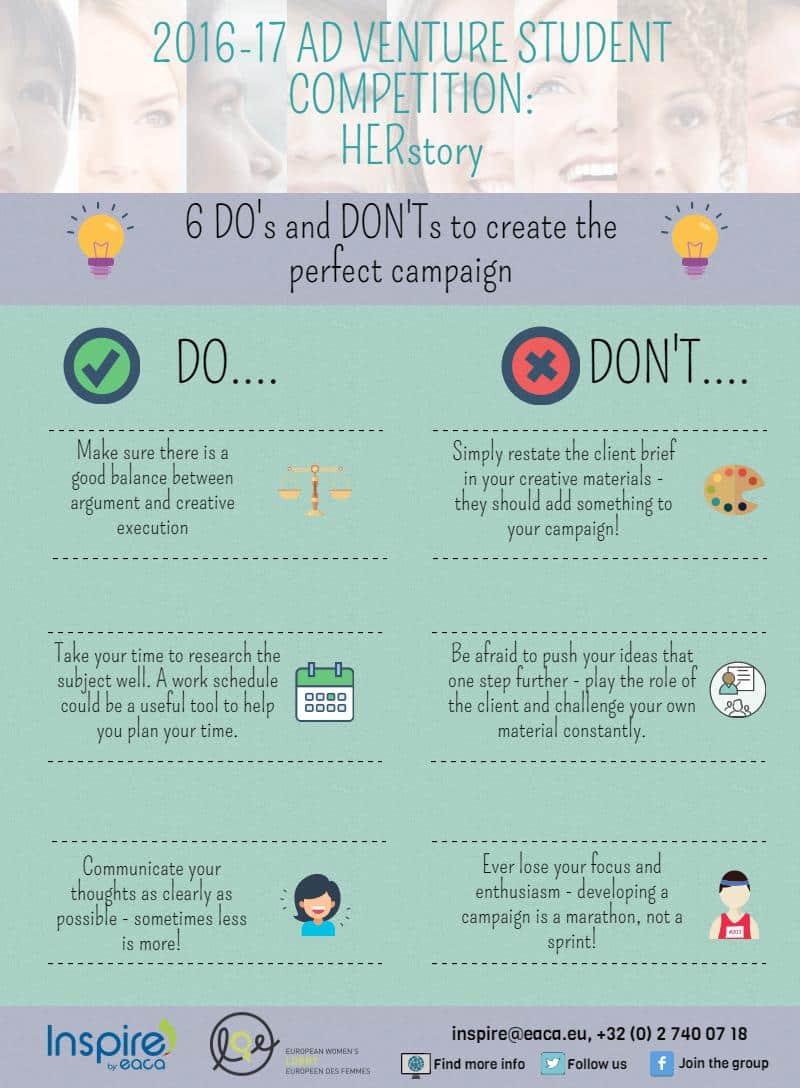
Processing the facts and opinions expressed in this Women in Media 2.0 Conference, it is clear that gender equality has become a ‘hot topic’ in the media and advertising industry. Through its Ad Venture Student Competition, EACA and edcom strive to contribute to this important debate by challenging students to create a communications campaign to raise awareness about gender inequality and restrictive gender stereotypes. EACA and edcom organise this competition in collaboration with this year’s client the European Women’s Lobby and will announce the winning campaign on 19 May 2017.

edcom Members Brussels Meeting – Providing a Framework for Members to Grow

“Ten years ago, we had a dream. Standing here today, I cannot believe what this dream has now become. I am so proud and it is all thanks to you”.

This is how EACA Director General Dominic Lyle opened the October 2016 edcom members meeting, which brought 35 representatives from 12 European countries to Brussels. Project updates and plans were presented and discussed ahead of the network’s 10th anniversary in 2017.

“edcom is a strong academic network. It is a framework within which members can grow.  Our main objective for the next 10 years is to build yet more bridges between academics and agencies”, continues Dominic Lyle.

All edcom members are in the field of commercial communications. The added value of edcom is that it provides a space for them to share challenges and best practices. It also gives their students the chance to participate in European competitions and European training sessions such as the Summer School.

At the meeting, edcom members enjoyed demonstrations of the brand new Inspire! website and the new digital format of the Annual Report. They were also updated on the development of established projects such as the Thesis Competition and edtalks, as well as the EACA Accreditation and Hall of Fame pilot projects currently being tested.

A particular focus was given to this year’s Ad Venture competition, which is being organised with the European Women’s Lobby. This year, students are challenged to design a campaign to highlight and tackle gender inequality and stereotyping in advertising.

A highlight of the meeting was when Wouter Tuybens took the stage to share with the participants his own experience of the 2016 Summer School. With an infectious enthusiasm, he explained that the Summer School allows students not only to learn more about advertising, but also about their own personal strengths and possible directions for their career in communications.

The 2017 Summer School is planned to take place in Prague from the 3rd to the 7th of July 2016.

Evolution Lab 2016: Rather than having a perfect CV, future talents in the advertising industry need to be creative and curious

On the 18th of October, EACA organised “Evolution Lab Forum”, an event bringing together professionals from the advertising industry and academics from the field of commercial communications. The main objective of the event was to discuss future needs of the industry.

What skills are needed for agency talents?

A panel discussion, moderated by Monique Gerritsen (Haute Ecole Economique et Technique, EPHEC) brought together:

  • Helen Brown, Global Chief HR & Talent Officer, MediaCom
  • Arnoud Versluis, NHTV University of Applied Sciences
  • Janet Markwick, COO, Grey EMEA
  • Richard Brooke, Media Operations and Strategy Director – Europe, Unilever

Its aim was to identify current skills gaps and future needs, determine which role education can and should play according to these needs and spot expectations from key players of the new complex advertising reality.

“I’m not looking for Instagram-picture-perfect young graduates. I’m looking for candidates with qualities such as critical thinking, curiosity and problem-solving skills” said Helen Brown, Global Chief HR & Talent Officer, MediaCom when asked what she was looking for when hiring a young graduate.

For jobs in finance or accounting, “hard skills” are needed, but for creatives or account managers, personality is essential. Janet Markwick, COO from Grey EMEA, underlined that “curiosity, creativity, and thinking out of the box is crucial in advertising; having just a degree is not sufficient anymore”.

Arnoud Versluis, Lecturer Marketing at NHTV, added that despite trends shifting in the industry, students still need a foundation to build further skills on. Furthermore, students need to be challenged and motivated by educational institutions as this is how they learn; it is essential to prepare them for the job market.

How to get a job in the industry?

Tips were given by Helen Brown on how to get a job in the industry as a young graduate, in particular on how to behave during an interview. “Students should do more research on how it is to work in the industry, network with industry professionals at fairs, follow and engage with them on Twitter, so that they are best prepared for the interview and know what working in an agency means” she said.

How can agencies attract and retain young talents?

It is no secret that millennials are often attracted to work for big companies such as Google or Apple. Richard Brooks, Media Operations and Strategy Director Europe, Unilever, agreed with that statement and commented that the main issue for those companies is the volume of people. Namely, they simply can’t employ enough people even though the demand to work for such big corporations remains high.

So how can agencies win the hearts of young graduates and later on, retain this talent? Following recent trends, young graduates might be interested to move on quickly in their careers by changing employers as soon as opportunities arise.

“To attract great talents you need to be a very attractive brand”, said Janet Marwick. “You have to create a culture where talents can grow. Young generations need to know they’re doing great work; the role of leaders is to nurture that talent through valuable feedback, so that talents stay.”